


Page 27 - 2026-2027 Travel Guide to Canada
P. 27
HOOFING IT
Moose are present in most forested wilderness
areas and, being adept swimmers, are often
seen in wetlands. Gros Morne National Park,
Newfoundland is an excellent viewing area all
year. Bull moose can be aggressive, particularly
during the autumn rut. Drive carefully in
moose country, especially at night; moose
encounters can cause serious damage.
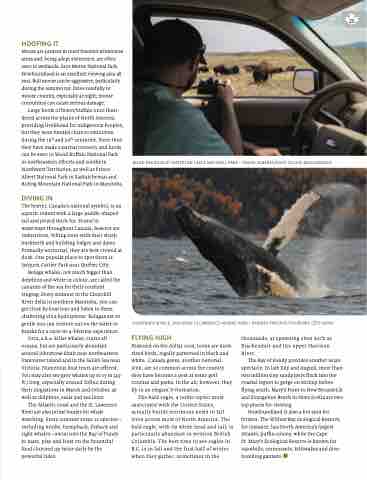
Large herds of bison/buffalo once thun-
dered across the plains of North America
providing livelihood for Indigenous Peoples,
but they were hunted close to extinction
during the 19th and 20th centuries. Since then
they have made a partial recovery and herds
can be seen in Wood Buffalo National Park
in northeastern Alberta and southern
Northwest Territories, as well as Prince
Albert National Park in Saskatchewan and
Riding Mountain National Park in Manitoba.
DIVING IN
The beaver, Canada’s national symbol, is an
aquatic rodent with a large paddle-shaped
tail and prized thick fur. Found in
waterways throughout Canada, beavers are
industrious, felling trees with their sharp
buckteeth and building lodges and dams.
Primarily nocturnal, they are best viewed at
dusk. One popular place to spot them is
Jacques-Cartier Park near Québec City.
Beluga whales, not much bigger than
dolphins and white in colour, are called the
canaries of the sea for their constant
singing. Every summer in the Churchill
River delta in northern Manitoba, you can
get close by boat tour and listen to them
chattering via a hydrophone. Belugas are so
gentle you can venture out on the water in
kayaks for a once-in-a-lifetime experience.
Orca, a.k.a. killer whales, cruise all
oceans, but are particularly abundant
around Johnstone Strait near northeastern
Vancouver Island and in the Salish Sea near
Victoria. Numerous boat tours are offered.
You may also see grey whales up to 15 m (49
ft.) long, especially around Tofino during
their migrations in March and October, as
well as dolphins, seals and sea lions.
The Atlantic coast and the St. Lawrence
River are also prime locales for whale
watching. Every summer some 12 species—
including minke, humpback, finback and
right whales—swim into the Bay of Fundy
to mate, play and feast on the bountiful
food churned up twice daily by the
powerful tides.
25
BISON PADDOCK AT WATERTON LAKES NATIONAL PARK • TRAVEL ALBERTA/KATIE GOLDIE @GOLDIEKATIE
HUMPBACK WHALE, SAGUENAY ST.LAWRENCE MARINE PARK • RENAUD PINTIAUX/TOURISME CÔTE-NORD
FLYING HIGH
Featured on the dollar coin, loons are duck-
sized birds, regally patterned in black and
white. Canada geese, another national
icon, are so common across the country
they have become a pest at some golf
courses and parks. In the air, however, they
fly in an elegant V-formation.
The bald eagle, a noble raptor most
associated with the United States,
actually builds enormous nests in tall
trees across most of North America. The
bald eagle, with its white head and tail, is
particularly abundant in western British
Columbia. The best time to see eagles in
B.C. is in fall and the first half of winter
when they gather, sometimes in the
thousands, at spawning sites such as
Brackendale and the upper Harrison
River.
The Bay of Fundy provides another avian
spectacle. In late July and August, more than
two million tiny sandpipers flock into the
coastal region to gorge on shrimp before
flying south. Mary’s Point in New Brunswick
and Evangeline Beach in Nova Scotia are two
top places for viewing.
Newfoundland is also a hot spot for
birders. The Witless Bay Ecological Reserve,
for instance, has North America’s largest
Atlantic puffin colony, while the Cape
St. Mary’s Ecological Reserve is known for
razorbills, cormorants, kittiwakes and dive-
bombing gannets.


