


Page 32 - 2026-2027 Travel Guide to Canada
P. 32
30
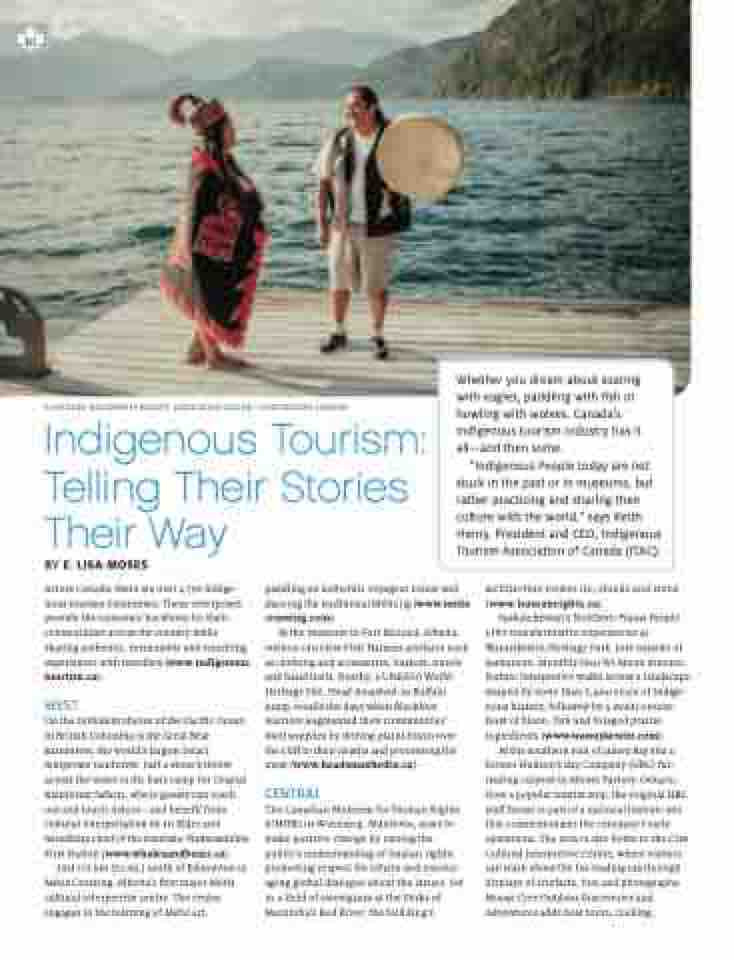
KLAHOOSE WILDERNESS RESORT, DESOLATION SOUND • DESTINATION CANADA
Indigenous Tourism:
Telling Their Stories
Their Way
BY E. LISA MOSES
Across Canada, there are over 2,750 Indige-
nous tourism businesses. These enterprises
provide the economic backbone for their
communities across the country while
sharing authentic, memorable and enriching
experiences with travellers (www.indigenous
tourism.ca).
WEST
On the turbulent shores of the Pacific Ocean
in British Columbia is the Great Bear
Rainforest, the world’s largest intact
temperate rainforest. Just a stone’s throw
across the water is the base camp for Coastal
Rainforest Safaris, where guests can reach
out and touch nature—and benefit from
cultural interpretation by an Elder and
hereditary chief of the Gwa’sala-’Nakwaxda’xw
First Nation (www.whalesandbears.ca).
Just 116 km (72 mi.) north of Edmonton is
Métis Crossing, Alberta’s first major Métis
cultural interpretive centre. The centre
engages in the learning of Métis art,
paddling an authentic voyageur canoe and
dancing the traditional Métis jig (www.metis
crossing.com).
At the museum in Fort McLeod, Alberta,
visitors can view First Nations artefacts such
as clothing and accessories, baskets, travois
and hand tools. Nearby, a UNESCO World
Heritage Site, Head-Smashed-in Buffalo
Jump, recalls the days when Blackfoot
warriors augmented their communities’
food supplies by driving plains bison over
the cliff to their deaths and processing the
meat (www.headsmashedin.ca).
CENTRAL
The Canadian Museum for Human Rights
(CMHR) in Winnipeg, Manitoba, aims to
make positive change by raising the
public’s understanding of human rights,
promoting respect for others and encour-
aging global dialogue about the issues. Set
in a field of sweetgrass at the Forks of
Manitoba’s Red River, the building’s
Whether you dream about soaring
with eagles, paddling with fish or
howling with wolves, Canada’s
Indigenous tourism industry has it
all—and then some.
“Indigenous People today are not
stuck in the past or in museums, but
rather practicing and sharing their
culture with the world,” says Keith
Henry, President and CEO, Indigenous
Tourism Association of Canada (ITAC).
architecture evokes ice, clouds and stone
(www.humanrights.ca).
Saskatchewan’s Northern Plains People
offer transformative experiences at
Wanuskewin Heritage Park, just outside of
Saskatoon. Monthly Han Wi Moon dinners
feature interpretive walks across a landscape
shaped by more than 6,400 years of Indige-
nous history, followed by a multi-course
feast of bison, fish and foraged prairie
ingredients (www.wanuskewin.com).
At the southern end of James Bay sits a
former Hudson’s Bay Company (HBC) fur-
trading outpost in Moose Factory, Ontario.
Now a popular tourist stop, the original HBC
staff house is part of a national historic site
that commemorates the company’s early
operations. The area is also home to the Cree
Cultural Interpretive Centre, where visitors
can learn about the fur-trading era through
displays of artefacts, furs and photographs.
Moose Cree Outdoor Discoveries and
Adventures adds boat tours, cooking


