


Page 73 - 2026-2027 Travel Guide to Canada
P. 73
visitors, whereas autumn promises brilliant
fall foliage and delectable harvest feasts.
Happily, a rapidly-growing number of
restaurants spotlight fresh, locally-sourced
ingredients.
Come winter, frozen ponds and lakes
provide an ideal setting for cutting figure
eights or playing pick-up hockey. Snow also
falls—as much as 400 cm (157 in.) annually
in northern New Brunswick—covering ski
hills and more than 8,000 km (4,971 mi.) of
groomed snowmobile trails.
In a place that has this much to offer,
there’s no need to rush. So take your cue
from the mighty Saint John River and simply
go with the flow.
WHAT’S NEW
New Brunswick is marketing itself to become
known as a mountain biking destination. The
province is well suited for this sport thanks to
its diverse terrain with the Appalachian
foothills, coastal cliffs, forests and river
valleys (www.tourismnewbrunswick.ca/
mountain-biking).
In Saint John, walk “the plank” at the Reversing
Falls from a 33.5 m (110 ft.) observation plank.
Look over the sides to see 1.2 billion-year-old
Precambrian age marble that collided with 515
million-year-old igneous rock. And check out
the rooftop theatre (www.theplank.ca).
New Brunswick’s vast forests and minimal
light pollution elevate its rising astro-
tourism scene. By 2026, expect 11 certified
Dark Sky Destinations—up from four in
2025—including the new 220-km (137 mi.)
Bay of Fundy Dark Sky Corridor, spanning
Hopewell Rocks to New River Beach, now the
world’s densest cluster (www.tourismnew
brunswick.ca).
Celebrate the 150th anniversary of Saint
John City Market, Canada’s oldest contin-
uing farmers’ market. Browse colourful
stalls brimming with local produce, seafood,
meats, and handmade goods, alongside
fresh grab-and-go fare (www.sjcity
market.ca).
In 2026, Fredericton is staking its claim as a
paddling paradise with a new Blue Trails
network tracing the Saint John River. More
than two dozen mapped routes span over
100 km (62 mi.), linking scenic waterways,
launch points, and local experiences—
positioning the capital among Canada’s
premier kayak and canoe destinations
(www.paddlingnb.ca/Routes/LowerSJRiver/
Fredericton.html).
CITY LIGHTS
Fredericton is rightly called “Atlantic
Canada’s Riverfront Capital.” The British
made it the seat of government 242 years ago
due to the easy access the Saint John River
provided, and most civic sites still line its
banks. Chief among them are the two-block
Garrison District, where red-coated troops
were once quartered; the copper-domed
Legislature; the neo-Gothic Christ Church
Cathedral; and the top-notch Beaverbrook Art
Gallery. Overlooking them all is the Univer-
sity of New Brunswick’s historic hilltop
campus (www.tourismfredericton.ca).
Saint John, a vibrant commercial and
cruise port, has been defined by its harbour
since the Loyalists sailed in. Evidence is
found in its 18th century waterside sites and
the grand edifices erected by later seafarers
during the “Golden Age of Sail.” The
harbour’s significance is further apparent in
Market Square, a museum and entertain-
ment complex fashioned from waterfront
warehouses, and the City Market which was
built by shipwrights. Even the Harbour
Passage Trail is named in its honour
(www.discoversaintjohn.com).
Straddling the muddy Petitcodiac River,
Greater Moncton has surpassed Saint John to
become the province’s most populous urban
centre. Originally nicknamed the “Hub City”
by virtue of its central location, it now
doubles as a hub of tourist activity because
Greater Moncton is home to attractions like
ST MARTINS SEA CAVES • NEW BRUNSWICK TOURISM
NB
71
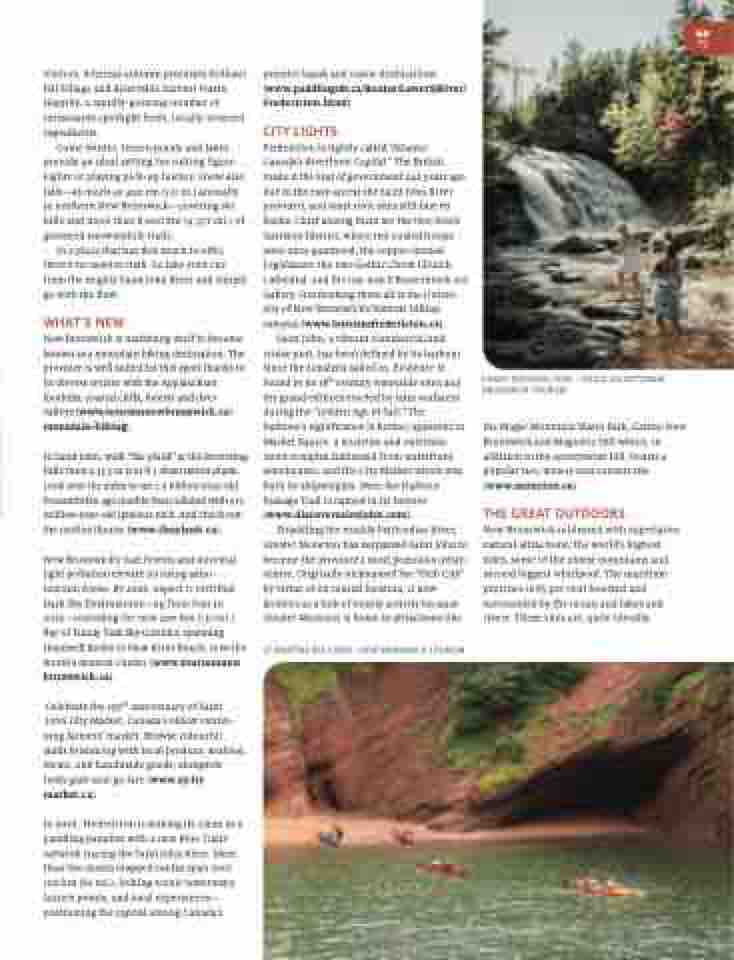
FUNDY NATIONAL PARK • EMILIE IGGIOTTI/NEW
BRUNSWICK TOURISM
the Magic Mountain Water Park, Casino New
Brunswick and Magnetic Hill which, in
addition to the eponymous hill, boasts a
popular zoo, winery and concert site
(www.moncton.ca).
THE GREAT OUTDOORS
New Brunswick is blessed with superlative
natural attractions: the world’s highest
tides, some of the oldest mountains and
second biggest whirlpool. The maritime
province is 85 per cent forested and
surrounded by the ocean and lakes and
rivers. These sites are, quite literally,

