


Page 78 - 2026-2027 Travel Guide to Canada
P. 78
NS
76
1,066,416
Halifax
www.novascotia.com
Halifax Stanfield International Airport, 35 km (22 mi.) from downtown
NOVA SCOTIA
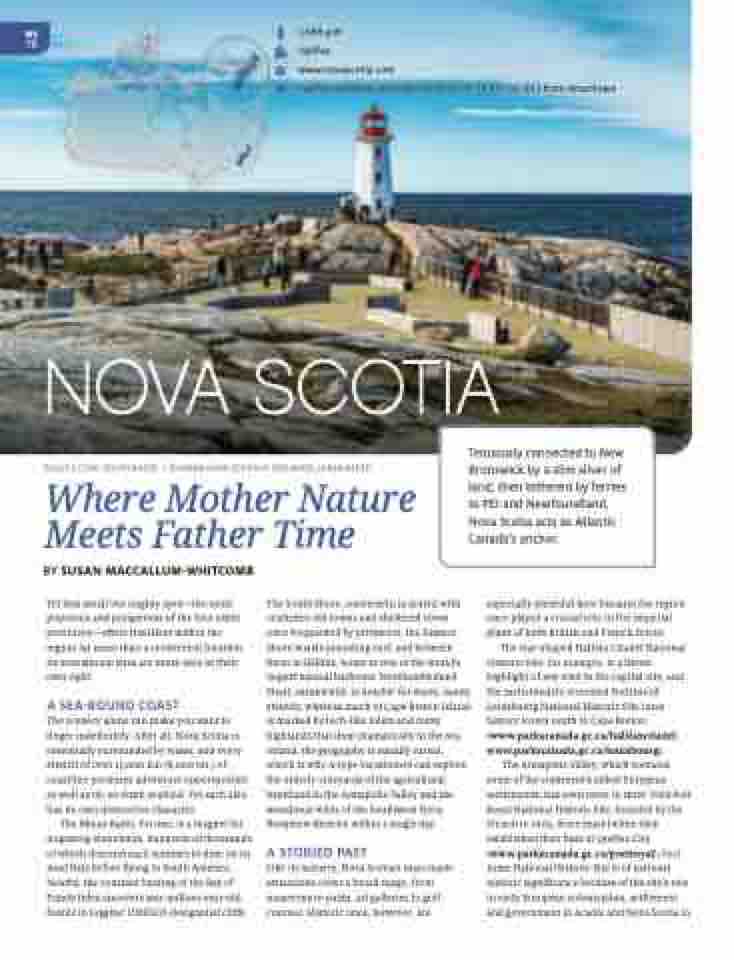
PEGGY’S COVE, SOUTH SHORE • TOURISM NOVA SCOTIA/© EDELWEISS_LOREN BEDELI
Where Mother Nature
Meets Father Time
BY SUSAN MACCALLUM-WHITCOMB
Tenuously connected to New
Brunswick by a slim sliver of
land, then tethered by ferries
to PEI and Newfoundland,
Nova Scotia acts as Atlantic
Canada’s anchor.
Yet this small but mighty spot—the most
populous and prosperous of the four sister
provinces—offers travellers within the
region far more than a convenient location.
Its sensational sites are must-sees in their
own right.
A SEA-BOUND COAST
The scenery alone can make you want to
linger indefinitely. After all, Nova Scotia is
essentially surrounded by water, and every
stretch of over 13,000 km (8,000 mi.) of
coastline promises adventure opportunities
as well as oh-so-fresh seafood. Yet each also
has its own distinctive character.
The Minas Basin, for one, is a magnet for
migrating shorebirds, hundreds of thousands
of which descend each summer to dine on its
mud flats before flying to South America.
Nearby, the constant beating of the Bay of
Fundy tides uncovers 300-million-year-old
fossils in Joggins’ UNESCO-designated cliffs.
The South Shore, conversely, is dotted with
centuries-old towns and sheltered coves
once frequented by privateers; the Eastern
Shore boasts pounding surf; and between
them is Halifax, home to one of the world’s
largest natural harbours. Northumberland
Strait, meanwhile, is notable for warm, sandy
strands, whereas much of Cape Breton Island
is marked by loch-like inlets and rocky
highlands that drop dramatically to the sea.
Inland, the geography is equally varied,
which is why A-type vacationers can explore
the orderly vineyards of the agricultural
heartland in the Annapolis Valley and the
wondrous wilds of the Southwest Nova
Biosphere Reserve within a single day.
A STORIED PAST
Like its scenery, Nova Scotia’s man-made
attractions cover a broad range, from
museums to parks, art galleries to golf
courses. Historic ones, however, are
especially plentiful here because the region
once played a crucial role in the imperial
plans of both British and French forces.
The star-shaped Halifax Citadel National
Historic Site, for example, is a literal
highlight of any visit to the capital city, and
the meticulously recreated Fortress of
Louisbourg National Historic Site lures
history lovers north to Cape Breton
(www.parkscanada.gc.ca/halifaxcitadel;
www.parkscanada.gc.ca/louisbourg).
The Annapolis Valley, which contains
some of the continent’s oldest European
settlements, has even more in store. Visit Port
Royal National Historic Site, founded by the
French in 1605, three years before they
established their base at Québec City
(www.parkscanada.gc.ca/portroyal); Fort
Anne National Historic Site is of national
historic significance because of the site’s role
in early European colonization, settlement
and government in Acadie and Nova Scotia in


