


Page 93 - 2026-2027 Travel Guide to Canada
P. 93
NU
91
guided by age-old timetables and
traditions. Though snowmobiles, boats
and guns have largely replaced dogsleds,
kayaks and harpoons, many Inuit continue
to hunt and fish to support their extended
families. Going out “on the land,” camping
throughout summer, collecting bird eggs
and picking berries are all traditions still
carried out. Women wear homemade
amauti jackets that keep their babies
tucked against their backs.
Drum dancing, throat singing, carving,
storytelling and sewing traditional clothes
are still practiced throughout Nunavut and
locals are happy to share the experiences.
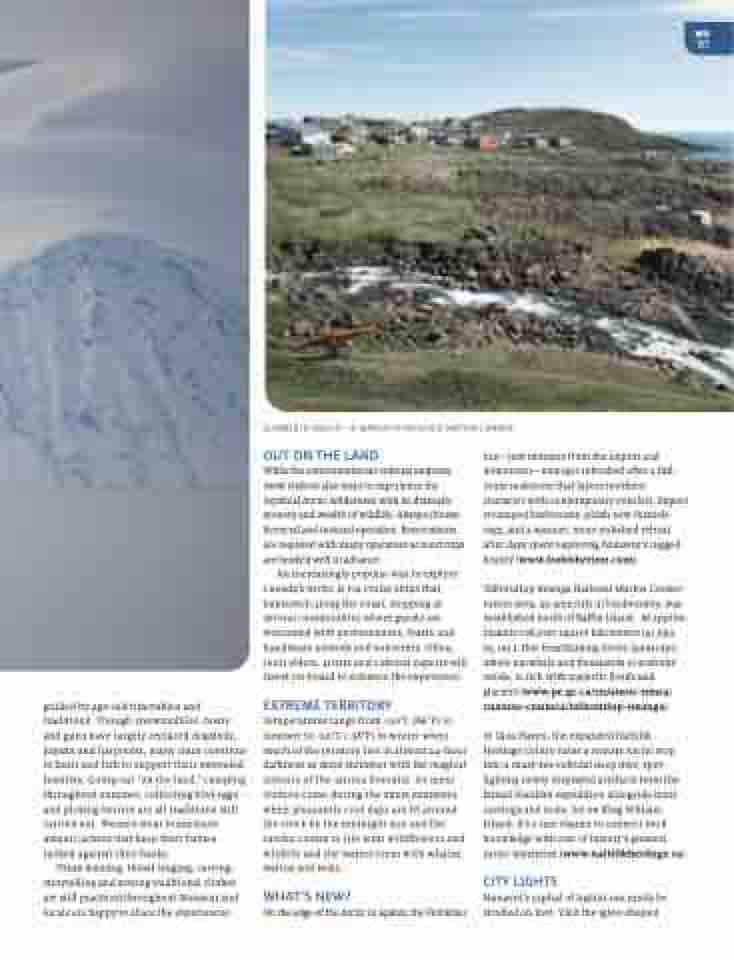
SUMMER IN IQALUIT • © MARLIN OLYNYK/DESTINATION CANADA
OUT ON THE LAND
While the communities are cultural outposts,
most visitors also want to experience the
mystical Arctic wilderness with its dramatic
scenery and wealth of wildlife. Always choose
licenced and insured operators. Reservations
are required with many operators as most trips
are booked well in advance.
An increasingly popular way to explore
Canada’s Arctic is via cruise ships that
hopscotch along the coast, stopping at
several communities where guests are
welcomed with performances, feasts and
handmade artwork and souvenirs. Often,
Inuit elders, artists and cultural experts will
travel on-board to enhance the experience.
EXTREME TERRITORY
Temperatures range from +30°C (86°F) in
summer to -50°C (-58°F) in winter when
much of the territory lies in almost 24-hour
darkness as skies shimmer with the magical
colours of the aurora borealis. So most
visitors come during the short summers,
when pleasantly cool days are lit around
the clock by the midnight sun and the
tundra comes to life with wildflowers and
wildlife and the waters teem with whales,
walrus and seals.
WHAT’S NEW?
On the edge of the Arctic in Iqaluit, the Frobisher
Inn—just minutes from the airport and
downtown—emerges refreshed after a full-
room makeover that layers northern
character with contemporary comfort. Expect
revamped bathrooms, plush new furnish-
ings, and a warmer, more polished retreat
after days spent exploring Nunavut’s rugged
beauty (www.frobisherinn.com).
Tallurutiup Imanga National Marine Conser-
vation Area, an area rich in biodiversity, was
established north of Baffin Island. At approx-
imately 108,000 square kilometres (41,699
sq. mi.), this breathtaking Arctic landscape,
where narwhals and thousands of seabirds
reside, is rich with majestic fjords and
glaciers (www.pc.gc.ca/en/amnc-nmca/
cnamnc-cnnmca/tallurutiup-imanga).
In Gjoa Haven, the expanded Nattilik
Heritage Centre turns a remote Arctic stop
into a must-see cultural deep dive, spot-
lighting newly displayed artefacts from the
famed Franklin expedition alongside Inuit
carvings and tools. Set on King William
Island, it’s a rare chance to connect Inuit
knowledge with one of history’s greatest
Arctic mysteries (www.nattilikheritage.ca).
CITY LIGHTS
Nunavut’s capital of Iqaluit can easily be
strolled on foot. Visit the igloo-shaped


